Scalia’s death likely to alter outcome in Friedrichs lawsuit
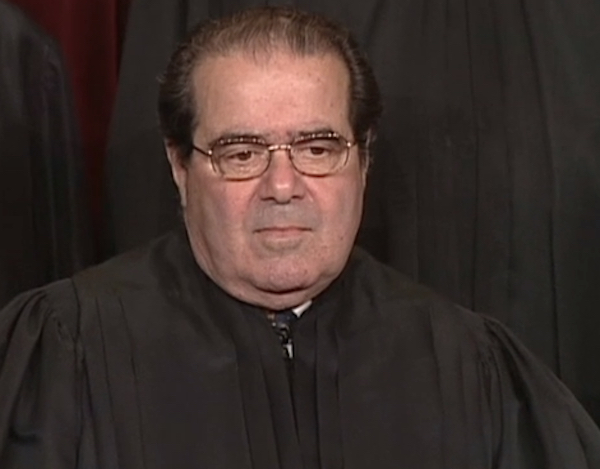
Antonin Scalia
The article was updated on Feb. 16 to include an analysis by SCOTUSblog publisher Tom Goldstein.
With the death of Supreme Court Justice Antonin Scalia, the California Teachers Association will likely gain an unexpected victory, at least for now, in its legal battle to continue the correct to require all teachers to pay the costs of collective bargaining.
That was the outcome raised in Friedrichs v. the State of California and the CTA, which the U.S. Supreme Court will rule on by June. Court observers had predicted that Scalia would join the four other conservative justices to make a 5-4 determination overturning Abood v. Detroit Board of Teaching, a four-decades erstwhile Supreme Court decision that said that states could require all public employees to separate the expenses of bargaining, known as "agency" or "fair share" fees.
A majority conclusion agreeing with the plaintiffs – Rebecca Friedrichs, an elementary school instructor in the Savanna School District in Anaheim and nine other non-union teachers – could severely weaken the financial health and political clout of the CTA and other public employee unions. The suing teachers debate that mandatory fees coerce them to support bargaining positions they disagree with, violating their constitutional right to gratis oral communication.
With a possible iv-4 tie, the court would defer to the ruling of the U.Due south. 9th Circuit Courtroom of Appeals on the side of the union. If that were to happen, the Court of Appeals determination would uphold only California's law permitting mandatory fair-share fees and non impact the other 2 dozen states that also have passed similar statutes. (Tom Goldstein, publisher of SCOTUSblog, suggests that the Supreme Court could decide to have cases similar Friedrichs reargued, one time Scalia'southward successor takes a seat on the court. Goldstein cites precedents for doing this in his article.) In the remaining "correct-to-piece of work" or open-shop states, in which all dues and fees are voluntary, unions generally are weaker and the percent of membership is smaller.
In its pro-forma ruling in 2014, the Appeals Courtroom didn't consider the merits of the example, nor was it asked to. The Washington, D.C.-based Middle for Individual Rights, which filed the lawsuit on behalf of the plaintiff teachers, had asked the lower courts to expedite a decision without a full trial and so that the Supreme Courtroom could straight reconsider the Abood conclusion.
The centre's lawyers had reason to believe the bulk on the court would concord with them. In a ruling in 2022 in a related case, Harris five. Quinn, Scalia and other conservatives called the Abood conclusion "troubling." Although the court didn't overturn Abood and so on technical grounds, Scalia and other conservatives in a concurring stance invited a lawsuit directly challenging it. The Friedrichs lawsuit was that claiming, and the court agreed last autumn to hear the case.
In establishing fair-share dues, the courtroom in Abood distinguished between collective bargaining expenses, covering pay and working conditions, and money to underwrite a wedlock's back up of candidates, its political positions and lobbying local schoolhouse boards and the Legislature on non-bargaining bug. Teachers are non obligated to pay for politicking, information technology said.
For California teachers, about $600 of their average $1,000 annual spousal relationship dues goes toward their fair-share fees; it is divided among their local wedlock, the California Teachers Association and the National Education Clan for their expertise and representation. Teachers who don't want to join the matrimony and pay the political portion of matrimony dues must annually sign a argument of their intention to opt out.
In a 1991 determination, Scalia defended the right of public-employee unions to charge fair-share fees to cover collective bargaining expenses, since they are legally required to negotiate on behalf of union and non-matrimony workers. Mandatory fees would solve the problem of "costless-riders" who benefited from the contract without paying for negotiation expenses, Scalia reasoned.
But in oral arguments in Friedrichs final month (come across page 45 of the transcript), Scalia indicated he had changed his mind and would join the other four conservative justices. "The problem is that everything that is collectively bargained with the government is within the political sphere, most by definition," including bargaining over pay increases, Scalia said, adopting the key argument of the plaintiffs.
The Center for Individual Rights' strategy of expediting its lawsuit may have backfired with Scalia'due south death. Whether the CTA and other public unions face some other lawsuit like Friedrichs whatsoever time soon volition depend on who becomes Scalia'south successor. President Obama would similar to make that selection – and, with his third date to the courtroom, tip control of the court to moderates and liberals. But Republican U.S. senators vowed Lord's day non to vote on a nominee, leaving the choice to the adjacent president.
The National Educational activity Clan and the American Federation of Teachers, the parent unions for the California Teachers Association and the California Federation of Teachers, a co-accused in the Friedrichs case, final year endorsed Democrat Hillary Clinton for president. With the court's ideological majority at present in the balance, Scalia'due south decease has raised the stakes in November for unions and their opponents.
In a statement Sunday, Joshua Pechthalt, president of the California Federation of Teachers said that Scalia's death "is likely to result in a delay of the Friedrichs example but it'south not certain and I think the public sector unions and the education unions have to go along the organizing we take been doing with the supposition nothing has changed."
But he too agreed that the vacancy on the court "underscores the importance of this presidential race." The next president could nominate one, mayhap more than Supreme Court judges, he said, adding, "These judges could be interpreting the constitution for the next generation, including bug related to labor, women'due south rights, voting rights, affirmative activeness, the environment and social justice."
To get more than reports like this one, click here to sign upwards for EdSource's no-toll daily e-mail on latest developments in education.
Source: https://edsource.org/2016/scalias-death-likely-to-alter-outcome-in-friedrichs-lawsuit/94818
0 Response to "Scalia’s death likely to alter outcome in Friedrichs lawsuit"
Post a Comment