California looks to Ontario schools’ reformer for guidance
Credit: Lillian Mongeau/EdSource Today
Michael Fullan at EdSource's 2022 symposium in Los Angeles
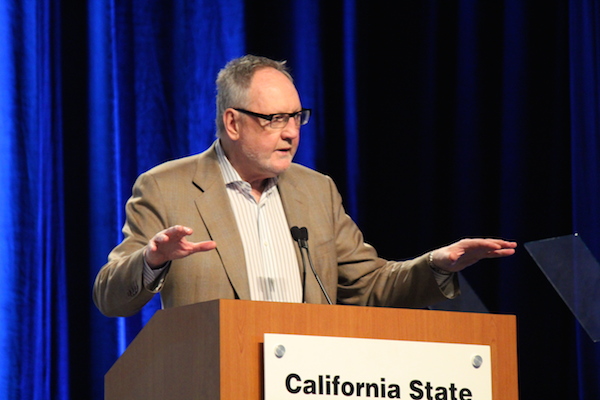 Credit: Lillian Mongeau/EdSource Today
Michael Fullan at EdSource's 2022 symposium in Los Angeles
Michael Fullan may be coming soon to a schoolhouse district near you.
The human credited with transforming the Canadian province of Ontario into 1 of the world's most effective school systems is ready to help California do the same. Fullan, though, would lead the state in a sharply different direction from the forced march that federal officials in Washington, D.C., have led over the past decade.
"I want California to become an alternative model to No Kid Left Backside; that would be a peachy thing to aspire to," Fullan said last month during an interview in Sacramento. Instead of improvement through the "negative drivers" of standardized testing and quick school turnarounds, he would shift the focus to improving instruction through "motivational collaboration" betwixt teachers and administrators.
California is full of education leaders eager to listen to, if not human activity on, his advice on systemic reform.
During his swing through Sacramento in April, Fullan:
- Led a four-hour give-and-take for near 100 administrators and employees at the State Department of Education on irresolute their mission from monitoring districts' program compliance to helping to build upwardly districts' strengths;
- Conducted an all-day seminar for 20 superintendents at the Superintendents Executive Leadership Forum, run by the UC Davis School of Education, on how the district part can back up classroom-based innovation;
- Dined with superintendents of the nine districts that have practical for a joint waiver from the No Kid Left Backside law; their application promises to comprise some of the methods that Fullan instituted in Ontario.
In March, Fullan had a wide-ranging, three-hour give-and-take with Gov. Jerry Brown, State Superintendent Tom Torlakson, California Teachers Clan President Dean Vogel, State Board of Education President Michael Kirst and State Board Executive Director Karen Stapf Walters during a dinner in Oakland. It was organized by Oakland Unified Superintendent Tony Smith and UC Davis School of Education Dean Harold Levine, who had previously discussed Fullan's piece of work with the governor. The purpose was to gauge any interest by the governor in pursuing Ontario-like reforms on a statewide basis.
Brownish'south sweeping plan for reforming the system for funding 1000-12 schools envisions a shift of controlling from Sacramento to districts; this is his "principle of subsidiarity." Fullan said his question, in plow, to Brown, is "How exercise you know local districts will have the capacity to take advantage of their freedom?"
Strong influence
In January and last fall, two delegations of California educators that included Torlakson, Chief Deputy Superintendent Richard Zeiger, California Commission on Teacher Credentialing Executive Director Mary Sandy, Vogel, Levine and a one-half-dozen superintendents and CEOs of charter management organizations made sojourns to Toronto, funded by the San Francisco-based Stuart Foundation.* There they observed classrooms and met with Fullan, teachers and provincial leaders near Ontario'due south strategy of school improvement.
Levine left impressed with what he saw in Toronto. Everyone they met with, from the provincial level to the schoolhouse sites, consistently talked about progress toward the same universal goals and credited Fullan and the premier who appointed him, Levine said.
Fullan has worked with Sanger Unified and Garden Grove Unified, where he led two days of discussions with teachers and administrators this year. Last month, he launched a 3-year project on edifice systemic change involving every school in four unified districts – Napa, Alameda, Pittsburg and San Lorenzo. It too is funded past the Stuart Foundation at $375,000 per twelvemonth and organized by the School of Education at UC Davis.
But his biggest involvement in California could come soon, if the federal Section of Education grants ix districts comprising the California Office to Reform Education, or Core, a first commune waiver from the No Child Left Behind law.
Fullan reviewed Core'south waiver application, which cites his writing and says that Cadre'south "alternative accountability model and day-to-day work" is motivated by the "changed civilization and positive and lasting improvements" in Ontario. The waiver

Michael Fullan with Rick Miller, left, executive director of the California Role to Reform Education, during a stop at Miller's role in Sacramento in April.
expresses conviction that the same philosophy – paying attention to data but using it every bit a ground to improve, not as a cudgel to declare failure – would work in California.
The well-nigh controversial idea in the Cadre waiver application – to give standardized tests for federal accountability purposes in only one grade per schoolhouse – was based on work in Ontario, where provincial tests are given in grades 3, 6 and 9, along with a literacy examination in grade x. Rick Miller, executive manager of Cadre and a former deputy state superintendent, said the Core districts have asked Fullan to piece of work with them if the waiver goes through, to see that the implementation is washed right.
"Michael is the moderating strength that pulls sides together," Miller said. He represents the "third way" and "center ground" between rejecting the methods of NCLB and renewing a commitment to its main goal, raising the accomplishment of all students.
Fullan, in the interview, was blunt: "NCLB has no credibility whatever now then information technology is easier to stride to the plate and push button against it. If I were Arne," he said, referring to Secretary of Education Arne Duncan, whom he has met, "I would encourage a quid pro quo – 'Prove us good ideas that are likely to work, and I volition indicate that we can be more flexible.'"
The Ontario experience
A professor emeritus and former dean at the Ontario Institute for Studies in Education at the University of Toronto, Fullan was already a renowned author and authority on big-scale schoolhouse reform when Ontario's newly elected Liberal Premier Dalton McGuinty asked him to be his special adviser on educational activity in 2004. With 2 one thousand thousand students in 72 districts and 5,000 schools, Ontario is a small-scale-scale version of California. Like California, its teachers are unionized; English language is not the primary linguistic communication spoken at home for 27 percent of families, and in Toronto, it is 57 percent – and this does not include French speakers, Fullan said. "People in the Us dismiss Republic of finland and Singapore as 'non similar united states,' but Ontario has similar geography and is English speaking. You can no longer say that you cannot learn from another jurisdiction."
In Canada, provincial governments, not the federal government, control pedagogy. When he became McGuinty'due south adviser, Fullan said in a 2022 published interview, progress had stagnated, and in that location was continual friction betwixt the provincial government and the four unions representing teachers.
The showtime footstep, he said, was "to send a bulletin … that we were going to show respect to teachers and commit ourselves to a focused partnership with a link to actual results."
The provincial regime set a few ambitious goals: amend the rates of proficiency in literacy and math and increase the graduation charge per unit. In the past 2 years, it has added a 4th goal: stage in a universal, full-time kindergarten to increase the percentage of children who are school-ready.
Improvement the start year fed on itself, he said, helping to establish a "collaborative culture to get teachers to work together, led by principals who know how to focus on instruction."
"By focusing on instructor evolution," Fullan wrote in a May 2022 article in The Atlantic, "Ontario was also able to heighten teacher accountability. Decades of experience accept taught Canadian educators that you can't get greater accountability through direct measures of rewards and punishments. Instead, what Ontario did was to establish transparency of results and do (anyone can notice out what any school's results are, and what they are doing to get those results) while combining this with what we call not-judgmentalism. This latter policy means that if a instructor is struggling, administrators and peers volition step in to help her get better." Because "collaborative competition" amongst teachers encourages experimentation, provincial intervention for schools that fail to improve is a last resort.
Rhonda Kimberley-Young, secretary/treasurer of the Ontario Federation of Teachers, agreed that McGuinty and Fullan took steps to involve teachers in the improvement procedure. "There was really a partnership on big-movie items," she said in an interview. "There was respect for the work that teachers do every bit professionals."
The creation of the Professional Learning and Leadership Program, providing grants to teachers "to practice what intrigues them and so build networks to share excellent resources, was symbolic of what the ministry building tried do at that time," Kimberley-Young said. Where the unions sometimes differed was on the employ of prove. "The drive to constantly compare data, with a light amplification by stimulated emission of radiation-like focus on numeracy and literacy, took abroad from an enriched classroom experience; it went too far," Kimberley-Young said.
There has been steady progress over seven years in meeting the original goals. Students coming together or exceeding goals on the province-broad tests in math and literacy rose for elementary grades from 54 percent to 70 percent, though shy of the target of 75 percent. Loftier schoolhouse graduation rates rose from 68 pct to 82 percent. Public conviction in schools rose from 43 percentage to 65 percent during that time. Ontario students' scores in reading on the 2009 international exam, Plan for International Student Cess, or PISA, were among the highest in the earth, ranking with Republic of korea and Republic of finland; scores were good, but not quite as high in math. Scores in scientific discipline on the Trends in International Mathematics and Scientific discipline Study (TIMSS) have declined over the by decade. (The OECD, the Organisation for Economical Co-functioning and Evolution, creator of PISA, devoted a chapter on Ontario in its 2010 publication, "Strong Performers and Successful Reformers in Pedagogy: Lessons from PISA for the Usa." In its 2010 report, How the World's Most Improved School Systems Proceed Getting Better, McKinsey & Visitor named Ontario, along with Long Embankment Unified and Aspire Public Schools in California, among the 20 well-nigh effective school systems in the globe.)
Correct and wrong drivers
Fullan contrasted Ontario'south strategy and the arroyo of the Usa through NCLB in a highly critical and widely circulated article, "Choosing the Wrong Drivers for Whole System Reform" (May 2011). The U.S. emphasis on "accountability – using test results and teacher appraisement to reward or punish teachers," its reliance in technology to spur improvement and its "fragmented strategies" are flat-out the wrong drivers for systemic improvement, he wrote. "And information technology is a mistake to lead with them."
The Obama administration compounded the problem, Fullan wrote, with Race to the Acme, the competitive grant for districts and states that required the adoption of Common Core standards, robust data systems, teacher evaluations linked to standardized test scores and prescribed methods to turn around the worst-performing schools. There is a identify for elements of those strategies in the "constellation of reform" but they will never establish the weather condition for reforming a whole organisation, whether a state or a district, because they don't change the "day-to-day culture of school systems." They don't build trust within schools and they don't focus on improving pedagogy.
"Throw a good appraisal system in a bad culture and you become nothing but increased alienation," he wrote.
Fullan'due south advice: "Jettison blatant merit pay, reduce excessive testing, don't depend on teacher appraisal as a driver, and don't treat earth-class standards equally a panacea."
In the EdSource interview, Fullan cited work in Sanger, where teachers from a cluster of three or iv schools meet several times each year to larn from one another about what works. Principals pb the discussions and set up high expectations, he said.
What's next?
No other state too California has expressed such intense interest, from state officials to a collaborative of districts to individual district leaders, in Fullan's work. Whether this will pb to a coherent involvement in setting country policy isn't clear.
The Cadre districts should learn within weeks whether they stand a proficient adventure for an NCLB waiver, creating an opening for Fullan.
Fullan characterized his conversation with Jerry Brown every bit inconclusive. "Jerry Brown was interested, but not convinced because of the lack of specificity. When I talked almost capacity building, he said, 'it sounds like jargon to me.' That was our fault, not his, just he followed up with lots of questions."
It'due south not apparent, even to those at the dinner, what the side by side step should be – and who should have information technology. Levine said he left the dinner with the understanding that there was a strong interest in pursuing the path of Ontario reforms in California. He said he was hoping that the State Section of Educational activity would write a white paper defining three or four mutual goals that Dark-brown, the Department and the Country Lath could agree on.
State Board of Educational activity President Michael Kirst said that "Fullan has momentum hither" considering and then many of those who went to Ontario returned, to a person, enthusiastic that the changes in Ontario would be a adept fit with California. Merely at this point, he said, "it's too general to say where we are with this." Someone has to turn Fullan'southward broad ideas into specifics, an operational plan for California. "What are the blueprints for following what he wants? What is the timeline? What are the costs?"
Torlakson agreed that it's still at an early stage, with a demand for a lot more word. He and other leaders at the land Department of Didactics have acknowledged the need to shift their role of enforcing state and federal mandates to sharing areas of expertise and best practices with the state'southward i,000 schoolhouse districts. Bringing Fullan to Sacramento was part of that effort to inspire his team. I Ontario innovation he'south interested in adopting, he said, is a fellowship programme in which a squad of teachers and principals rotate in and out of the Ministry of Education, sharing their perspective on running schools with government officials.
Christy Pichel, president of the Stuart Foundation, said that what attracted the foundation to Fullan was "the thought of changing the culture of a school by developing not just individual skills of teachers but past creating conditions where teachers work together to meliorate conditions for learning and education." What makes Fullan singled-out is that "he was able to do this across an unabridged province and big districts in a systematic way."
Tom Timar is executive manager of the Center for Applied Policy in Education (CAP-Ed) at the UC Davis School of Education, which has brought Fullan to its annual superintendents' seminar for half-dozen straight years and is analogous the four-district project for system reform that Fullan is leading. He said he has come to agree with Fullan that "real alter will not come from meridian-down intervention strategies. They must be grassroots, collaborative, and professionalized with teachers working with administrators for a common crusade."
He'd similar to see the evolution of a statewide collaborative of districts, non unlike what CORE is proposing in its waiver application, only bigger. "Fullan would be the one to provide leadership and expertise on how to pull these groups together. He'd exist the glue," Timar said.
If the land Section of Pedagogy looks at Ontario and sees "a convergence of ideas," Stuart would be willing to bring them together, Pichel said.
"Ontario is a neighbor," she said, "and Michael Fullan has a detail involvement to help California if California wants to learn from him."
* Notation: The Stuart Foundation is a funder of EdSource.
To get more reports like this one, click here to sign upward for EdSource's no-cost daily email on latest developments in instruction.
Source: https://edsource.org/2013/california-looks-to-ontario-schools-reformer-for-guidance/30644
0 Response to "California looks to Ontario schools’ reformer for guidance"
Post a Comment